
Hermína Týrlová
Filed under: People, Animator, Artist, Director, Film designer, Filmmaker, Puppeteer, Sculptor, Czech Republic, Czechoslovakia, Hermína Týrlová, V, Ziln Studios,
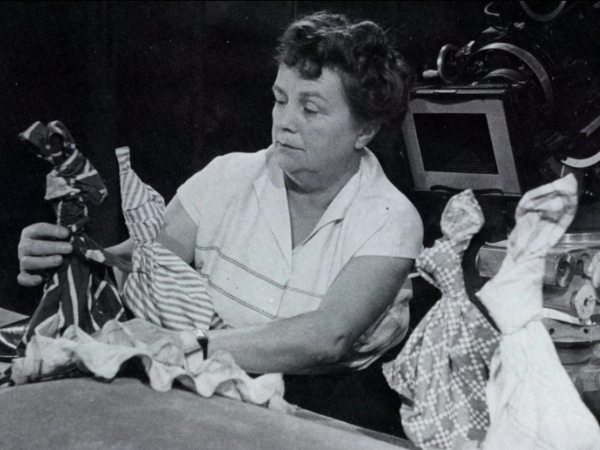
Týrlová in her studio
Full Name:Hermína Týrlová
Occupation / Title:Animator, Artist, Director, Film designer, Filmmaker, Puppeteer, Sculptor
Date of birth:11/12/1900
Date of death:03/05/1993
Birthplace:Březové Hory, Czech Republic
Associated studios:- Zlin Film Studio
Biography
Hermína Týrlová was a Czech animator, director, and puppeteer who made films from the 1920s up to the 1980s. She is often referred to as the “mother of Czech animation” for her contributions to animated film within the country. (Barker, 1) She was a lifelong director, producing sixty films over the course of her life including Vzpoura Hraček/Revolt of the Toys (1947) and Uzel Na Kapesníku/The Knot in the Handkerchief (1958). (Ročňáková, 5)
Family and early life
Týrlová was born on December 11th, 1900, in Březové Hory, a town in the modern-day Czech Republic. Her family worked in mining; however, both of her parents died by the time Týrlová was twelve. From the ages of twelve to fourteen she lived in an orphanage before moving to Prague to start work in 1914. (Barker, 2)
During her time in Prague, Týrlová worked as a stage actress and spent her free time working on illustrations and cartoons for children. In the early 1920s, she met her future husband Karel Dodal, who brought her to work at the publication Elekta Journal. (Barker, 2)
Career outline
Týrlová started her career working at Elekta Journal, where she helped to produce newsreels, advertisements, and educational films. At Elekta, Týrlová and her husband Karl Dodal made their first animated film Zamilovaný Vodník/The Waterboy in Love (1928). (Ročňáková, 1)
In the early 1930s, Elekta shut down and Týrlová started to make films for the Ministry of Agriculture. However, she was unable to secure enough funding from the government to produce any films. During this time Týrlová and Dodal separated, but the two remained friends and Týrlová went to work at Dodal’s production company, IRE-Film, in 1934. In 1936, she made her first feature film Tajemství Lucerny/The Secret of the Lantern, which was released to large commercial success and furthered funding for her work. (Ročňáková, 2-3)
Týrlová’s filmmaking slowed down leading up to World War Two, as Dodal left the country, leaving her without a studio and producer. In the early 1940s, she returned to work in animation at the Zlín Film Studio. After the War, her films began to receive accolades among film festivals in Europe. In 1947, she released her most famous film Vzpoura Hraček/Revolt of the Toys. After Toys, she would go on to make several films including Ukolébavka/Lullabye (1948), Uzel Na Kapesníku/The Knot in the Handkerchief (1958), and Vláček Kolejáček/The Little Train (1959). (Ročňáková, 4)
Týrlová continued to make films through the 1960s and 1970s, with her final film The Tale of the String in 1985. (Ročňáková, 5)
Personal style
Týrlová is known for a childlike, multimedia style that features a mixture of fibers, puppets, wooden toys, and household items. (Barker, 1)
Honors and awards
Týrlová’s work has received many awards, including the Lion of San Marco at the 1966 Venice film festival, for her film Snehulák/The Snowman. She also received a Lifetime Achievement Award at the 1981 Paris International film Festival. (Ročňáková, 5)
Filmography
[Show/Hide]
References:
Barker, Jennifer Lynde. “Crafting Animation: Hermína Týrlová’s Fuzzy Modernism.” MAI: Feminism and Visual Culture, December 13, 2021, Accessed November 5, 2025. https://www.maifeminism.com/crafting-animation-hermina-tyrlova-fuzzy-modernism/
Ročňáková, Hana. “Hermína Týrlová (1900-1993).” Poznej Příbram,, Accessed November 5, 2025. https://www.poznejpribram.cz/en/osobnosti/hermina-tyrlova-1900-1993