
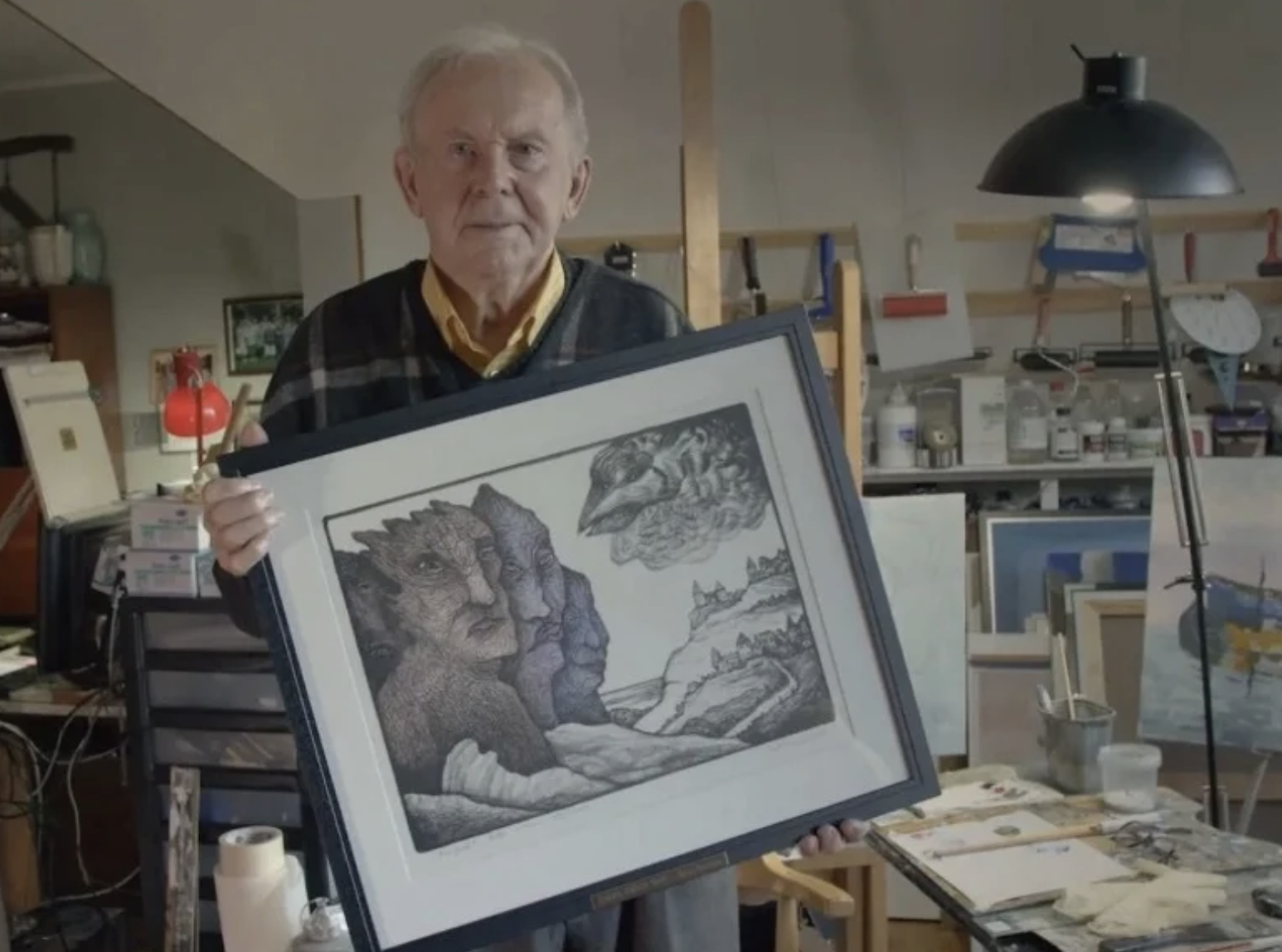
 Full Name:
Rein Raamat
Occupation / Title:Animator, Artist, Background Artist, Filmmaker, Producer
Date of birth:20/03/1931
Birthplace:Türi, Estonia
Associated studios:- Talinnfilm
- Joonisfilm
- Nukufilm
Biography
Rein Raamat is an Estonian animator, director, and artist. Known for his abstract style, Raamat was a pivotal figure in establishing a local animation industry in Estonia. (Swieringa, 2020)
Family and early life
Raamat was born in the town of Türi, Estonia on March 20th 1931. He began his art career by studying painting at the Estonian Art Institute. After completing his degree in 1957, he went to work as an animator at Nukufilm. (Swieringa, 2020)
Career outline
Raamat developed his skills as an animator while working as an art director and production designer at Nukufilm in the late 1950s. Nukufilm, a division of the Estonian film studio Tallinnfilm, was largely focused on puppet and object animation. (Swieringa, 2020) In 1958, he worked with the director Elbert Tuganov on Little Peter’s Dream, the first puppet animation film to come out of Estonia. (Trossek, 2023)
During the 1960s, Rammat would continue to work on both animated and live action films with Tallinnfilm, including Lalu Sober (1962), The Milkman of Mäeküla (1965), and Postmark from Vienna (1968). Due to his technical skill and ability to work within the content restrictions set on films by the Soviet Union, Rammat soon became one of the first Estonian animators to have his work distributed internationally. (Swieringa, 2020)
In 1972, Raamat started a cel animation division of Tallinnfilm, named Joonisfilm, in collaboration with the Russian animator Fedor Khitrouk. (Swieringa, 2020) Unlike previous animation divisions at Tallinnfilm, Raamat’s goal with Joonisfilm was to create films made for adults. He also wanted to make films whose content would challenge Soviet film restrictions by working in themes of sexuality, drug use, and Estonian nationalism into his projects. Joonisfilm was also known for Raamat’s highly collaborative style, as he would encourage collaboration between musicians, artists, and writers in every step of the production process. (Elu, 2022)
At Joonisfilm, Raamat directed some of his most famous works, such as Colour-Bird (1974), Hell (1984), and Tyll the Giant (1980). In the late 1980s and early 1990s, Raamat turned to making documentary films. In this later period of his career, he made over 20 documentary films, including, Grisha (1996), Maire Männik 54 Rue Du Montparnasse (2000) and The Kings of Time (2008). His documentary work primarily focused on telling the stories of Estonian artists and filmmakers. In particular, The Kings of Time is a film about the creation of the animation studio Nukufilm. (Esti Film)
Personal style
Rammat’s animation work was heavily rooted in his background as a painter, with most of his animated films having a large emphasis on artistic design and visual art. During his career, Rammat was influenced by many art styles and movements induing German expressionism, modernism, and the avant-garde. Stylistically, his films often blended psychedelic, pop-art, and surrealist styles. His emphasis on style and visuals was incredibly important in helping his films by-pass Soviet censorship. (Trossek, 2023)
Filmography
[Show/Hide]
References:
Elu, Eesti. “The Founders of Estonian Animation” Issuu-Estonian Life, no. 32 https://issuu.com/estonianlife/docs/eestieluno32august12/s/16576828 , Aug, 12, 2022 Accessed Jan, 10 2026.
“Rein Raamat” Estonian Film Database, https://www.efis.ee/en/keyword/44378 Accessed Jan, 10 2026.
Swieringa, Bob. “Rein Raamat” ASIFA, https://asifa.net/2020-rein-raamat/, Jan, 6, 2020. Accessed Jan, 10 2026.
Trossek, Andreas. “Pop Art in Animation Behind the Iron Curtain” Apparatus Journal, https://apparatusjournal.net/index.php/apparatus/article/view/355/652, 2023, Accessed Jan, 10 2026.